
Parenting a child who trusts themselves
Let me tell you about a moment that took my breath away and brought tears to my eyes.
A few weeks ago, my family took a little trip. My son was hanging out with a few kiddos close to his heart, playing the popular game “Roblox” on his tablet* under a massive kitchen fort they had all built.
*The merits of technology, dopamine hits and growing brains could definitely be debated, but that’s for another day.
Both the kids he was playing with insisted, terrified for their safety and my son’s, “if you play Roblox, you’re gonna go to JAIL!”
I heard this and my spidey senses all lit up; still, I decided to not intervene just yet. Good thing, too, because without missing a beat, my son unwaveringly responds:
“well, that hasn’t happened to me!”
And on he goes with his play…
In that moment, I couldn’t be more proud of my son and his ability to stand his ground, rooted in his own truth, unshaken by another’s fear or perspective on life when it did not map to the truth of his experience.
Now, I have been working with adults for over five years and one theme that keeps showing up is that they are unable to tell the difference between what is the voice of truth and what is the voice of cultural conditioning (mother, father, authority figures, god).
But there are a few ways to know which voice is speaking, here’s a few to consider about what to pay attention to.
The voice of truth:
Is clear and simple. Shows up as a yes / no; up /down; stay / leave.
Speaks from and to the moment.
Is impulsive, so the first thing you hear.
Is quiet yet persistent.
Cannot lie.
Is spacious.
Moves you toward potential.
The voice of conditioning:
Muddy, filled with blah blah blah – stories, fears, should’s, expectations, demands.
Speaks to the fears of the past or warnings about the future.
Is conditioned, so it shows up the nanosecond after the truth.
Is loud, invasive, unforgiving, relentless, rooted in fear / shame / despair / rage / and is persistent.
Seeks to protect you based on the past.
Feels constricting.
Keeps you locked in what you know.
Most women I work with don’t realize they have at least two voices in their head at all times. Many confuse their authentic voice for that of someone else. When no one has taught you how to differentiate them, you just think they’re all you.
They’re not.
So for the next week or so, I invite you to consider asking yourself a simple question about a simple experience in your life:
Is this true for me, yes or no?
And just listen for the clear intuitive impulse – the first thing you hear.
Then, of course, notice how quickly the other voice takes over and tries desperately to convince you otherwise.
Let me give you an example of what I mean, because this doesn’t have to complicated:
“Do I feel like washing the dishes right now?” Yes / no. “Do I want to eat right now?” Yes / no. “Do I want to drive to work today?” Yes / no.
You’ll hear the answer, and then you’ll hear the chainsaw of unwelcoming thoughts trigger, saying something along these lines “Sure, Stela, I obviously don’t want to wash the dishes but someone has to and don’t you know that if I don’t wash them then they’ll get dirty and noone else around here and can do it well anyway so I have to and I wish they would load the dishwasher properly but what can you do men are like this and you know what I like a clean kitchen anyway and I need to cook and how can I do with with a dirty kitchen and anyway I’m exhausted it’s been a long day I wish I could nap but I can’t because the food will rot and we’ll get mold and everyone will die so I HAVE TO wash them now..........”
So, what’s actually required for you to hear the truth of your experience?
Presence.
If you are not present in the moment that you are in, the cultural conditioning (programming) is unconsciously running the show of your life.
That’s how you find yourself repeating patterns that you know you’ve long ago outgrown, or patterns that hurt you or your children, or patterns that repeat the status quo no matter how much you hate it.
I know it’s hard to hear this, but I’m in the business of the tough conversations. Because we all intuitively know “love and light” simply won’t cut it. Avoiding the tough conversations with ourselvesis what’s causing the pain and suffering. It is what’s causing distraction and destruction. It is what’s causing children’s terror of a simple game.
What if, instead, we modeled:
presence to our childrenso they know they matter?
staying in the tough conversations with ourselves so that they can feel free to explore theirs?
curiosity (over certainty) so they can question what they experience rather than take it as fact (because someone bigger than them said it)?
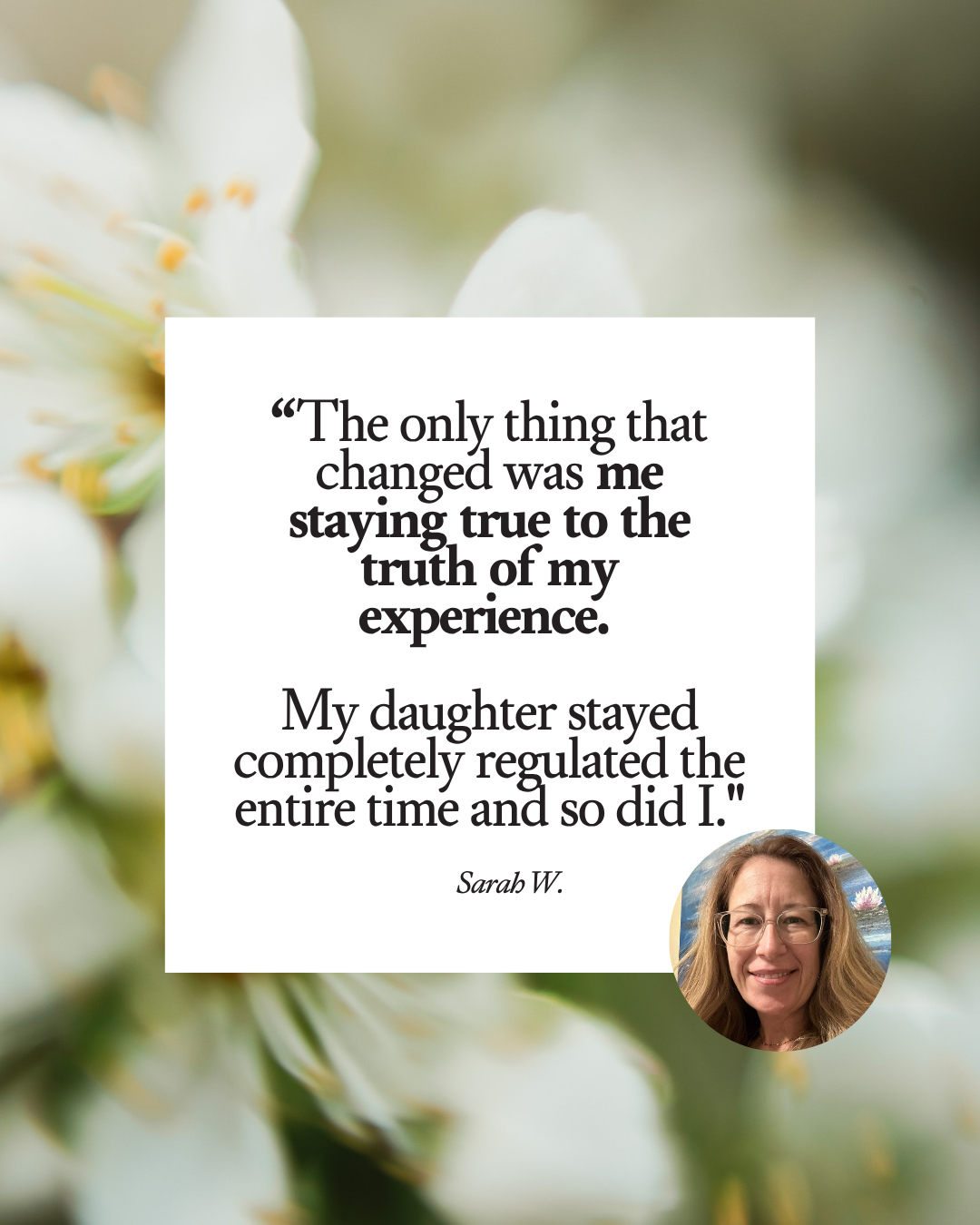
from Sarah’s latest blog on shifting reality, found here.
Sarah is one of the women I work with. She is the living embodiment of what happened when she stopped making “the problem” about her daughter and turned inward instead. The shifts that she and her daughter are living leave me in awe. She wrote about it here.
If you’re curious how your programming has created your personality and how that impacts the choices you make today, check out this quiz.
If this resonated, you might also like..



What becomes possible in a state of surrender is anything.