
The truth doesn’t clutter — hiding it does
If you’d rather listen than read, you can sit with the audio version of this here.
There are moments that show you exactly how you’ve been living—whether you’re ready to see it or not. Decluttering, it turns out, is one of them.
Last night I decluttered every room in the house. I took everything out of every closet and laid it all bare, right there on the floor, so I could filter through it. I went through every piece of paper hiding in a drawer — including taxes from 2006. Every spice in the cabinet got organized into glass jars. Every piece of clothing found its new home.
But boy, what a mess the process can be. But that mess is how the process works.
Decluttering our home and decluttering our mind are similar processes. Before anything can be reorganized or released, it needs to come out of the closet first. It needs to be looked at, evaluated, and then chosen.
But most of us are raised to believe that whatever is deemed impolite or inappropriate must stay buried deep. The more we can control those feelings, the more civilized we are considered.
So we learn early on to stuff even more into an already overfull closet — to the point where the door won’t shut, and everyone can see the mess spilling out but we all pretend it ain’t so bad.
In the physical realm, the logic is clear: You can’t get rid of what you don’t know is hiding in the back.
The same is true for our internal world.
But there is a fundamental difference: Mental, emotional, and spiritual decluttering is often far more painful because we’re terrified of what we’ll find. We fear what it might mean about who we are, what we’ve done, how we’ve lived, or how others might react.
So instead of bringing things up to sort through them, we suppress them. We avoid the discomfort, feel overwhelmed by the potential mess, and, the worst part is, we convince ourselves we’re not capable of handling it.
This is how we create an internal double bind: when we don’t air things out and sort them through, they fester. They rot. And that shows up in ways we don’t always link to the original clutter, things like anxiety, depression, addiction, chronic exhaustion, disconnection. Most of us are dragging around emotional dead horses we haven’t named — and still wonder why we feel stuck.
The only way to loosen the double bind is to find a way to feel safe enough to tell the truth of your experience to yourself, decloak it fully, and choose — consciously — what stays and what goes.
But how often do we declutter what clutters our mind? Our body? Our beliefs? How often do we even think about our habits, thought patterns, and inherited scripts from 1977 that we’re still carrying?
So I’ll leave you with some questions. Take a few deep breaths, and ponder. Bonus points if you hit reply and tell me what comes up.
How many outdated beliefs that you know no longer serve you are you still carrying? Can you name the first three that pop up?
For what purpose do you continue to hold on to them? Is it to be polite? Not trigger your father-in-law? Keep up with tradition? Keep the peace? Stay in control? In other words — how does holding on to those outdated, potentially harmful beliefs actually serve you? Because on some level, it’s intelligent. Even if it’s no longer aligned. So how is it serving you? What does keeping them mean for you?
Curious why you keep holding on to things that no longer serve you, even when you know better?
Take our Truth or Trauma Quiz to uncover what’s really running the show behind your choices. It’s quick, eye-opening, and might just name the thing you've never been able to put your finger on.
Because here’s the thing — we live in a post-AI, post-truth world that is overflowing with misinformation. Becoming able to be discerning is what’s going to separate those who thrive from those who survive in the next few decades.
Discernment doesn’t come from more information – you cannot cram more insight into an already overwhelmed system. It comes from discovering safety in the body. It comes from our ability to discern what to take in and what to let go of. Discernment of what’s real and what’s not. What’s relevant and what’s not. What you can use and what’s just noise.
We’ve been told for centuries that knowledge is power. But I’ve come to believe it’s only partly true. Knowing better doesn’t necessarily equal doing better.If it were true, you wouldn’t still be wondering why you snapped at your life partner yet again over something as insignificant as the dishwasher being loaded wrong.
This is why most people stay stuck – they live the familiar way while gathering more insights for how to live differently — all while holding on to belief systems that say they can’t or shouldn’t.
Without different choices, there can be no better life. A better life demands that we make better choices. Choices that are aligned with the truth that we carry, decloaked. This is not something culture teaches, but something we must rediscover ourselves. Choosing concurrently is a skill that demands you become discerning of what matters and what doesn’t, what aligns and what’s outdated.
If what you know isn’t actually changing how you live, then it’s not integration — it’s entertainment. And there’s nothing wrong with entertainment, as long as you’re honest about what it is. But pretending information-as-entertainment will lead to transformation? That’s a recipe for disappointment, resentment, and life lived trapped in the closet.
This is what the illusion that “knowledge is power”, uncontextualized, sells us.
And the truth of it is that, for most people, gathering insight feels like progress because it’s entertaining. It gives us a healthy and needed dopamine hit that, when engaged further intentionally for integration, literally shifts our brain and nervous system.
So integration is the key to living well.
The body does the processing – because it knows how. You don’t have to think about how new neuropathways form and the electrical signals along the route – it just happens. All you have to do is become intentional about your evolution and integrating your “aha” moments into how you live.
When you live intentionally, your life becomes the reflection of a series of intentional choices. You get to choose, here and now, how well organized you want your closet to be… and your life.
What does this look like in real life?
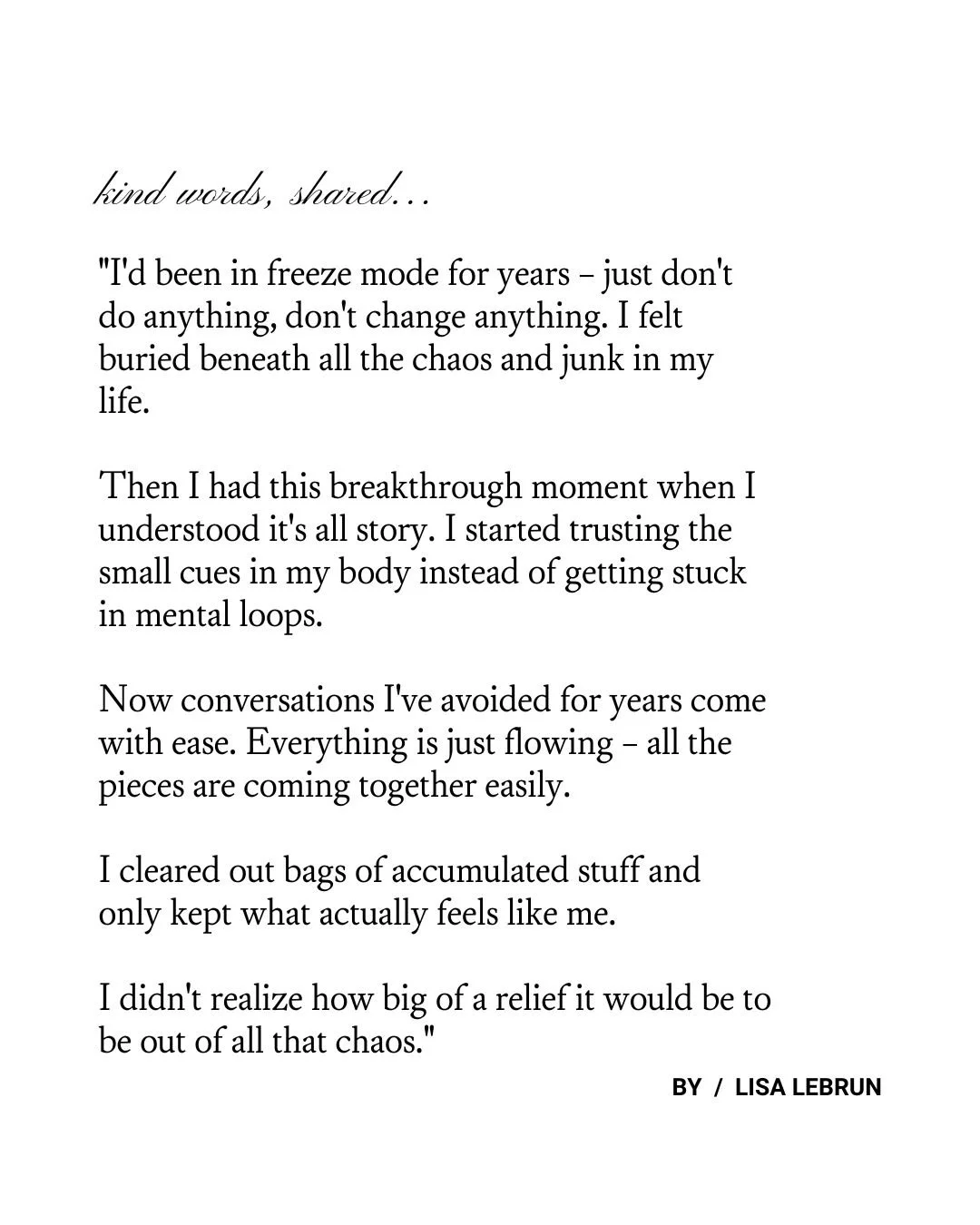
Here’s how one woman moved through this process — from clutter to clarity, from stuck to spacious.
If you crave support …
Want a space that honors growth as a process and invites insight to become lived experience? That’s what the The Inner Ecosystem is all about.
Choose what meets you where you are …
New to our world and want to explore before diving deeper? The Authentic Living Library was created for you.
If you know better but still react the same, this will tell you why. Take the quiz to find out.
Want a deeper dive? Check out the timeless audio course that begins the process.
If this resonated, you might also like..

What becomes possible in a state of surrender is anything.